
Do the Driving Modes in Cadillac Lyriq Offer Different Ranges or Battery Usage?
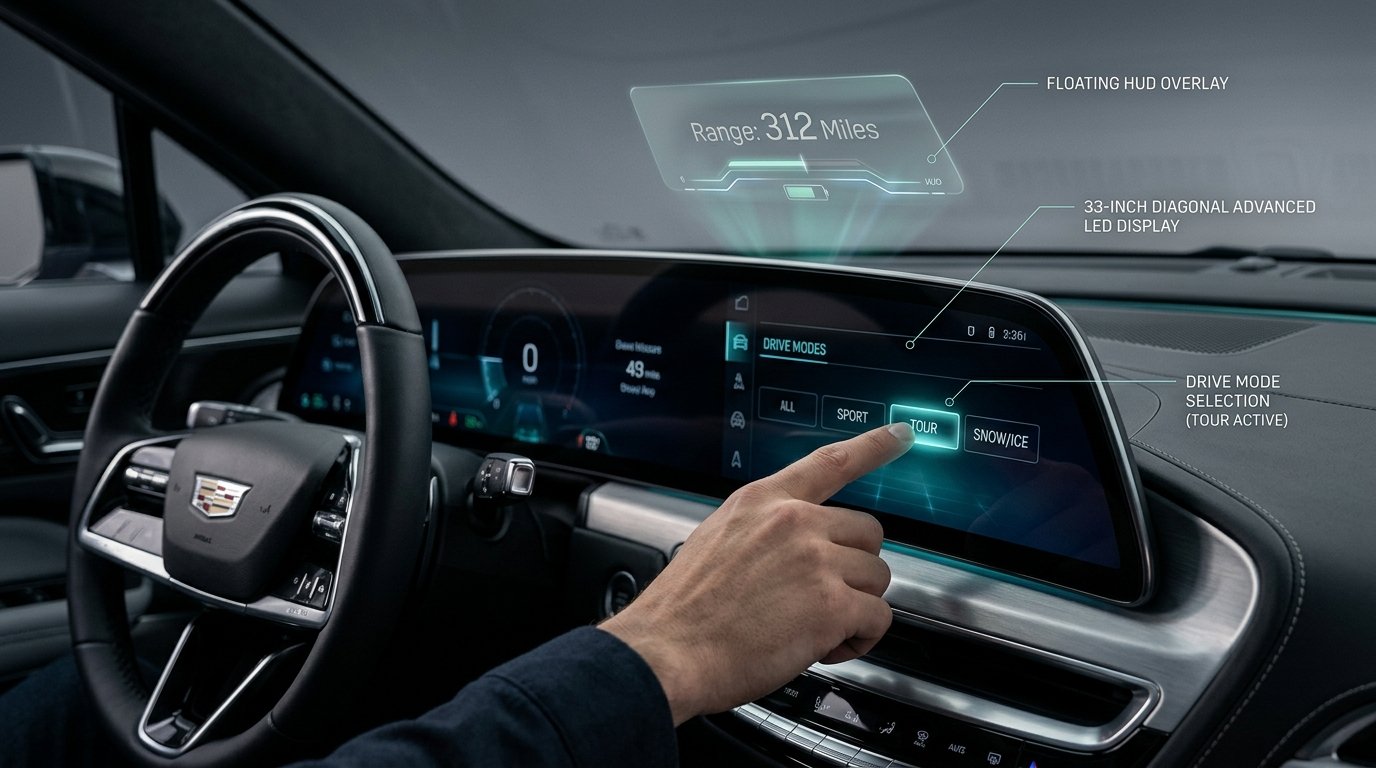
The Cadillac Lyriq has different driving modes that change how the vehicle responds to the driver. However, these modes do not give the Lyriq separate official battery ranges. Instead, the selected mode can change how the vehicle delivers power, which may affect energy use during a drive.
For Lyriq owners, this means the driving mode can have an effect on efficiency, but it does not work like choosing between different battery sizes or fixed range settings. Real-world range can also change because of speed, weather, temperature, road conditions, climate control, driving style, and other factors.
How Driving Modes Work in the Cadillac Lyriq
Driving modes are designed to change the way the Lyriq behaves on the road. They can affect areas such as acceleration response and the overall feel of the vehicle.
The battery itself does not suddenly become larger or smaller when a driver changes modes. The available stored energy remains in the battery. What can change is how that energy is delivered and how much electricity the vehicle uses during a particular trip.
This is an important difference.
If a driver selects a mode that allows stronger acceleration, for example, the vehicle may use more energy when the driver makes frequent hard accelerations. A calmer driving style in a less aggressive mode may help reduce energy use.
That does not mean one mode always gives a specific number of extra miles. The actual result depends on how the car is driven.
Do Different Lyriq Modes Have Different Official Ranges?
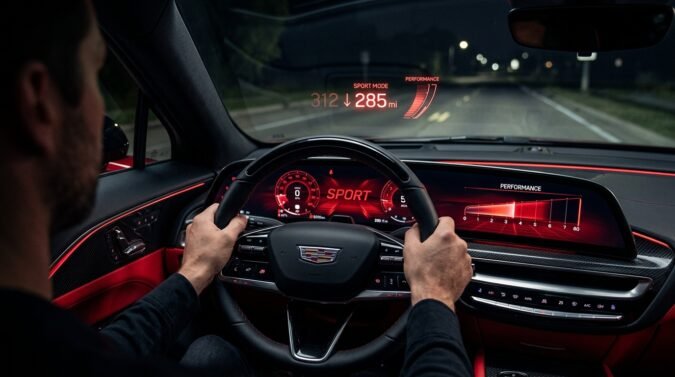
Not in the sense of having a separate range rating for each driving mode.
An EV’s advertised range is not normally a simple number that changes every time the driver selects a different mode. Range ratings are based on standardized testing conditions, while everyday driving can be very different.
The Lyriq’s estimated range should therefore be viewed as a general guide rather than a promise of how many miles the vehicle will travel in every situation.
For example, two Lyriq drivers could use the same driving mode but get different results. One driver may travel mostly on city streets at moderate speeds, while another may drive at higher highway speeds. Their energy consumption can be very different.
Can a Driving Mode Change Battery Usage?
Yes, a driving mode can influence battery usage indirectly.
The biggest factor is how the vehicle responds to the accelerator and how the driver uses that response. If a mode makes the vehicle feel more responsive, a driver may use more power during acceleration.
However, selecting a particular mode does not automatically mean the battery will drain quickly.
The driver still has a major effect on energy consumption. Smooth acceleration, steady speeds, and avoiding unnecessary high-speed driving can help an electric vehicle use energy more efficiently.
Other systems in the vehicle also use electricity. Heating and cooling the cabin, for example, can affect how much energy remains available for driving.
Why Range Can Change Even in the Same Driving Mode
Driving mode is only one part of the range picture.
Several other conditions can change how far a Lyriq can travel on a charge.
Driving Speed
Speed can have a major effect on an EV’s energy consumption. Higher speeds generally require more energy because the vehicle has to overcome greater air resistance.
A Lyriq driven at a steady moderate speed may use energy differently from one driven quickly on a highway.
This is why an owner’s real-world range may not match the vehicle’s official estimate on every trip.
Acceleration
Strong acceleration requires more electrical power.
A driver who frequently presses the accelerator hard may use more energy than someone who accelerates smoothly.
This can happen regardless of which driving mode is selected.
Weather and Temperature
Cold or very hot weather can affect EV efficiency.
The battery and cabin systems may need additional energy to maintain suitable operating conditions. Heating or cooling the cabin can also increase electricity use.
As a result, a Lyriq may show a different estimated range in different weather conditions.
Climate Control
Air conditioning and heating use electricity.
If climate control is used heavily, some of the battery’s energy is being used for comfort rather than moving the vehicle.
This does not mean drivers should avoid climate control. It simply helps explain why the displayed range can change.
Road Conditions
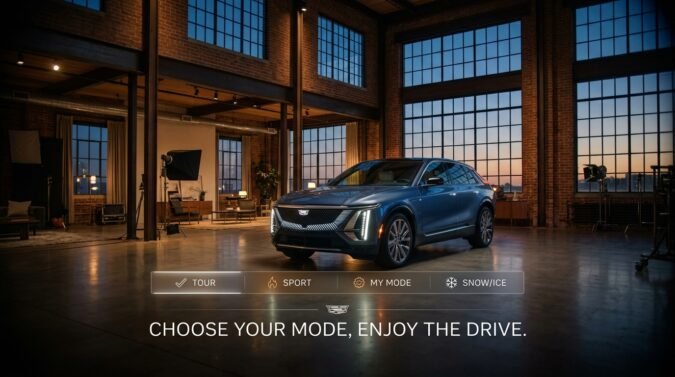
Hills, traffic, road surfaces, wind, and other conditions can affect energy consumption.
A trip with long climbs may use more energy than a similar-distance trip on flatter roads.
Heavy traffic can also change efficiency because the vehicle repeatedly slows down and accelerates.
What Happens When You Change Modes?
Changing the driving mode changes the vehicle’s driving behavior, not the physical capacity of its battery.
Think of the battery as the same energy source regardless of the selected mode.
The mode determines how the vehicle uses that energy.
For example, a driver may select a mode that provides a different accelerator response. The car can then feel more relaxed or more responsive depending on the setting.
If the driver takes advantage of stronger acceleration often, energy consumption can rise.
If the driver changes modes but continues to drive gently, the difference in total energy use may be smaller.
This is why it is difficult to say that one mode will always provide a certain number of additional miles.
Does a More Powerful Driving Mode Always Reduce Range?
No.
A more performance-focused driving setting does not automatically mean the Lyriq will lose a fixed amount of range.
The effect depends on how the driver uses the vehicle.
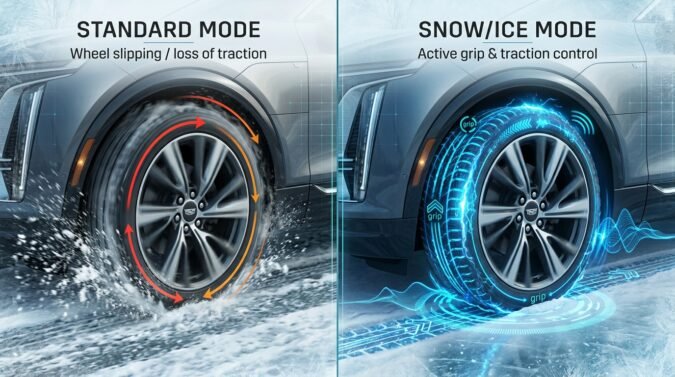
If a driver selects a more responsive mode but drives at a steady speed without frequent hard acceleration, the difference in energy use may be limited.
On the other hand, a driver who repeatedly uses strong acceleration can consume energy faster.
The same principle applies to many electric vehicles: the vehicle’s behavior and the driver’s actions work together to determine real-world energy consumption.
What About Regenerative Braking?
Regenerative braking is another important part of EV energy use.
When an electric vehicle slows down in a way that allows energy recovery, some of the vehicle’s kinetic energy can be converted back into electrical energy and sent to the battery.
This can help improve efficiency compared with simply wasting all of that energy as heat through conventional friction braking.
However, regenerative braking does not create free energy or completely replace the energy used during acceleration.
The amount of energy recovered depends on the driving situation and how the vehicle is operated.
A driver should therefore not expect a particular driving mode to produce a guaranteed range increase simply because it uses regenerative braking.
Does City Driving Use More or Less Battery?
It depends on the conditions.
City driving includes many stops and starts, which can increase energy use through repeated acceleration. At the same time, lower speeds can reduce aerodynamic losses compared with high-speed highway driving.
Regenerative braking can also recover some energy when the vehicle slows down.
Because of these factors, city driving cannot simply be labeled as always better or always worse for range.
Traffic, temperature, road layout, driving style, and climate control all matter.
Does Highway Driving Reduce Lyriq Range?
Highway driving can use more energy because vehicles generally face greater aerodynamic resistance as speed increases.
This means a long highway trip at high speed can produce different efficiency results from slower driving.
A driver planning a long journey should therefore pay attention to the vehicle’s current range estimate rather than assuming the official maximum range will always be available.
Wind, temperature, road elevation, traffic, and speed can all change the result.
Can the Lyriq Show Estimated Range While Driving?
The vehicle’s range estimate can change as driving conditions change.
An EV’s displayed range is an estimate based on available battery energy and expected energy consumption. If recent driving uses more electricity, the estimate can fall faster.
If the vehicle is driven more efficiently, the estimate may behave differently.
This is why the number shown on the dashboard should not be treated as a fixed countdown where every mile driven always equals exactly one mile removed from the displayed estimate.
For example, a driver could travel several miles while seeing the estimated range decrease by a slightly different amount. The system is continually estimating future energy use.
Is It Better to Stay in One Driving Mode?
Not necessarily.
The best mode depends on what the driver wants from the vehicle.
For everyday driving, a driver may prefer a setting that provides a comfortable and predictable response. For other situations, a different mode may provide a driving feel the driver prefers.
If maximum efficiency is the priority, the most useful approach is not simply choosing a particular mode and expecting a fixed range increase. It is better to combine sensible mode selection with efficient driving habits.
That includes smooth acceleration, reasonable speeds, and limiting unnecessary energy use.
How to Get Better Range From a Cadillac Lyriq
Drivers who want to make the most of the Lyriq’s battery can focus on several simple habits.
Accelerate Smoothly
Hard acceleration can use a large amount of electrical power. Smooth acceleration is generally a better approach when efficiency is the main goal.
Keep Highway Speeds Reasonable
Higher speeds can increase energy consumption. Keeping speeds moderate can help reduce the amount of energy required for a trip.
Use Climate Control Wisely
Heating and cooling the cabin can use battery energy. Using climate settings sensibly can help preserve energy, especially during extreme temperatures.
Watch the Range Estimate
The range display can help drivers understand how current driving conditions are affecting expected travel distance.
It is useful to check the estimate before a longer journey and monitor it during the trip.
Plan Charging Stops
For long trips, charging planning is more reliable than trying to stretch the battery to the last possible mile.
Drivers should consider the trip distance, weather, traffic, available charging locations, and a reasonable buffer.
Is Battery Usage the Same in Every Driving Mode?
No.
The amount of energy used during a trip can vary with driving mode and, more importantly, how that mode is used.
But it would be misleading to say that each mode has a fixed battery consumption rate.
There is no simple rule such as “Mode A always uses 10% more battery than Mode B.” Real-world energy use changes from trip to trip.
A driver using an aggressive mode gently may use less energy than another driver using a normal mode with frequent hard acceleration.
The driver’s behavior can therefore be more important than the name of the selected mode.
Does Changing Modes Change the Battery Capacity?
No.
Changing the driving mode does not physically change the size or capacity of the Lyriq’s battery.
The battery remains the same battery.
What changes is how the vehicle responds and how electrical power may be delivered during driving.
This distinction is useful because some drivers may assume that selecting an efficiency-oriented setting somehow unlocks additional battery capacity. It does not.
Instead, efficient driving can help a driver use the available energy more effectively.
Why the Same Lyriq Can Get Different Range Results
Two identical Lyriq vehicles can produce different real-world range results.
Consider two drivers starting with the same battery charge.
The first driver travels at moderate speeds, accelerates smoothly, uses limited climate control, and drives on relatively easy roads.
The second driver travels faster, accelerates strongly, faces cold weather and strong wind, and uses heating or cooling heavily.
Even though both vehicles started with the same battery level, their energy consumption can be very different.
This is normal for electric vehicles.
The estimated range is therefore best understood as a changing prediction rather than a guaranteed distance.
What Should Lyriq Owners Focus On?
If the main goal is maximum range, focusing only on the driving mode can miss the bigger picture.
A better approach is to look at overall energy use.
Driving smoothly and avoiding unnecessary high speeds can make a meaningful difference. Weather and climate control should also be considered when planning longer trips.
Drivers should also remember that the range estimate can change as the vehicle learns from recent driving conditions.
The most useful question is not simply, “Which mode gives me the most miles?”
It is, “How can I use the Lyriq’s available battery energy efficiently for this trip?”
Do driving modes in the Cadillac Lyriq offer different ranges?
Driving modes do not provide separate fixed range ratings. They can change how the vehicle responds and may affect energy consumption depending on how the vehicle is driven.
Does a sportier driving mode use more battery?
It can, especially if the driver frequently uses stronger acceleration. However, there is no fixed amount of additional battery use that applies to every trip.
Does changing the driving mode change the Lyriq’s battery size?
No. The physical battery capacity does not change when the driving mode is changed.
Which factor has the biggest effect on Lyriq range?
There is no single factor for every trip. Speed, acceleration, temperature, climate control, road conditions, traffic, and driving style can all affect energy consumption.
Can regenerative braking improve efficiency?
Regenerative braking can recover some energy during deceleration. It can help efficiency, but it does not recover all of the energy used to accelerate the vehicle.
Why does my Lyriq’s estimated range change?
The estimated range can change because the vehicle is continually accounting for battery charge and expected energy consumption. Recent driving conditions can influence the estimate.
Should I use a specific mode for the best range?
There is no universal mode that guarantees the highest range in every situation. Efficient driving habits, moderate speeds, smooth acceleration, and sensible use of climate control can all help.
Final Answer
The Cadillac Lyriq’s driving modes can affect how the vehicle uses and delivers battery power, but they do not create separate fixed ranges or change the physical battery capacity.
The biggest difference comes from how the vehicle is driven. A mode that encourages stronger acceleration can lead to higher energy use when the driver takes advantage of that response. However, the actual effect varies from trip to trip.
For the best possible range, Lyriq drivers should look beyond the driving mode. Speed, acceleration, weather, climate control, traffic, road conditions, and driving habits all play a role in how much battery energy a journey requires.