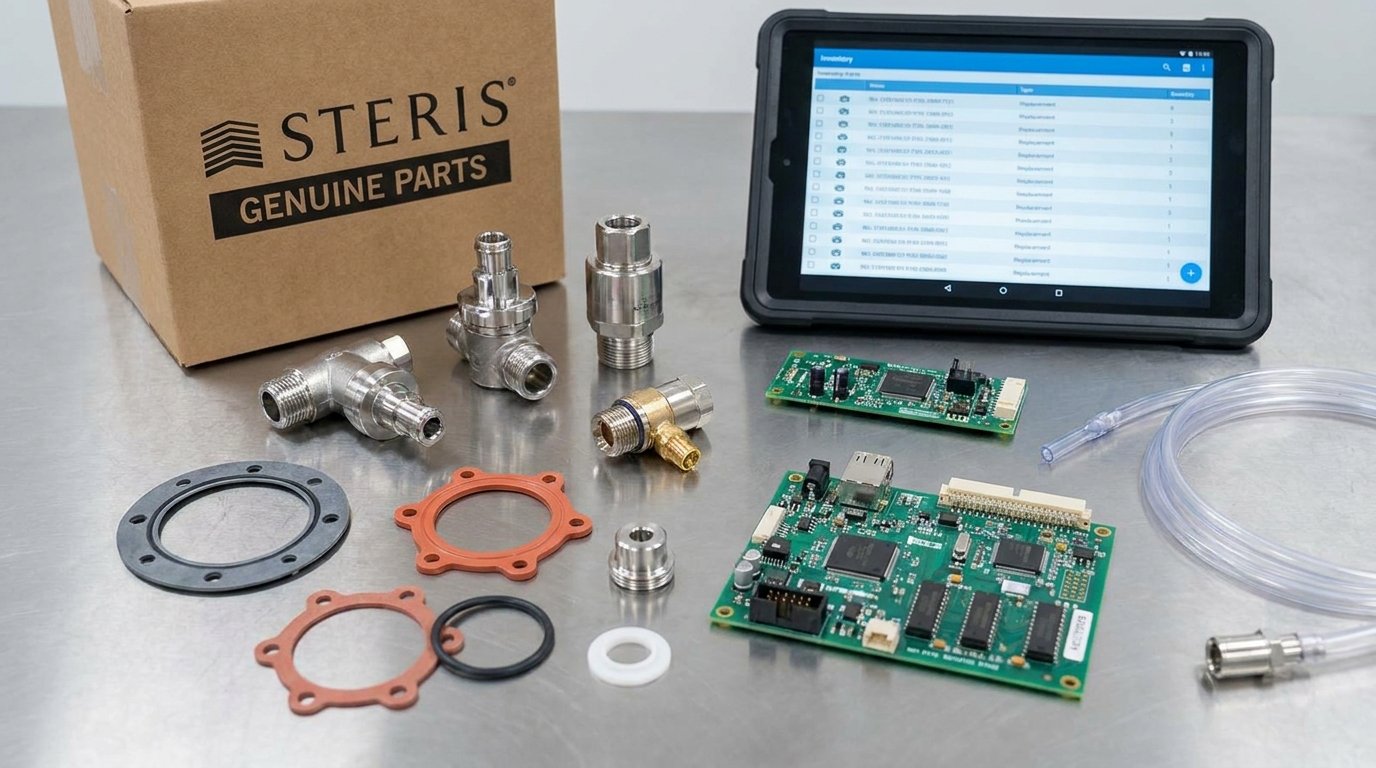
STERIS Parts: How to Find, Identify, and Order the Right Replacement Parts
STERIS parts are replacement components, accessories, and maintenance items used with equipment made by STERIS. These products support hospitals, laboratories, pharmaceutical manufacturers, and other facilities that depend on reliable cleaning, sterilization, and decontamination systems.
If you need a replacement part, the most useful starting point is the official Shop STERIS website. You can search by product name, part number, keyword, or equipment serial number. The site also provides illustrated parts diagrams to help users identify the correct item.
Choosing the right component takes more than matching its appearance. Equipment model, serial number, part specifications, and service requirements can all affect compatibility. This guide explains how to find STERIS parts, compare replacement options, place an order, and make informed maintenance decisions.
What Are STERIS Parts?
STERIS parts are components intended for use in compatible STERIS equipment and systems. They can range from small replacement items to larger mechanical or electronic assemblies.
The company serves several industries, including healthcare, research, biotechnology, and pharmaceutical manufacturing. Its equipment and services cover areas such as instrument cleaning, sterilization, decontamination, and sterile processing.
steris.com
+1
A facility may need replacement parts for different reasons. A component might wear out through normal use, become damaged, fail during operation, or need replacement as part of scheduled maintenance.
Common reasons to look for STERIS parts include:
- Replacing a worn or damaged component.
- Carrying out scheduled preventive maintenance.
- Repairing equipment after a fault.
- Restoring a system to its specified operating condition.
- Preparing for planned servicing.
- Keeping suitable spare parts available to reduce repair delays.
The exact part depends on the equipment and the problem. A component designed for one sterilizer or washer-disinfector may not be suitable for another model, even if the two machines look similar.
For this reason, buyers should confirm the part number and equipment compatibility before ordering.
Types of STERIS Parts and Replacement Components
STERIS supports a broad range of equipment. The parts you need will depend on the machine, its purpose, and the type of maintenance required.
The official online store organizes parts by equipment category, making it easier to narrow a search to the correct product group.
1. Sterilizer and autoclave parts
Steam sterilizers, often called autoclaves, use controlled conditions to process suitable instruments, materials, or equipment. These machines contain several mechanical and control components that may need attention during their service life.
Depending on the model, replacement parts may include:
- Door seals and related sealing components.
- Valves and valve repair kits.
- Steam system components.
- Sensors and switches.
- Control components.
- Parts used in scheduled maintenance.
For example, the official Shop STERIS catalog lists items such as door seals, steam trap repair kits, and valve repair kits. These examples show the range of parts available, but they are not universal replacements for every sterilizer.
Before ordering, confirm the exact equipment model and part number. A seal that fits one chamber may have different dimensions from a seal used in another model.
2. Washer-disinfector parts
Washer-disinfectors clean reusable items through a controlled washing process and, where applicable, a disinfection stage.
These machines may use pumps, valves, spray systems, sensors, seals, and other parts. Some components are subject to wear and may need replacement under the equipment’s maintenance plan.
When searching for washer-disinfector parts, identify the machine’s exact product family. Also check whether the item is a complete assembly, a repair kit, or an individual component.
The distinction matters because a repair kit may contain several items needed to service one assembly, while an individual part may not include everything required for the repair.
3. Operating room equipment parts
STERIS also supplies operating room equipment, including surgical tables, surgical lights, and related systems. Its service offerings cover maintenance and repair for this equipment.
Replacement components vary by product. A surgical table, for example, has different requirements from a sterilizer or a washer.
For this type of equipment, buyers should check the product documentation and obtain technical advice when a part affects movement, electrical control, patient support, or other safety-related functions.
Do not assume that a component is compatible simply because it has the same shape or connector as the original.
4. Laboratory and pharmaceutical equipment parts
STERIS also serves research laboratories and pharmaceutical and biotechnology facilities. Its product range includes laboratory glassware washers, steam generators, water purification systems, and other specialized equipment.
Parts for these systems may include mechanical components, valves, sensors, controls, and maintenance items.
The correct replacement depends on the equipment’s design and operating needs. In a laboratory or production setting, a repair may also require records, checks, or testing before the equipment returns to service.
For this reason, maintenance teams should follow the applicable equipment instructions and site procedures rather than relying on a general parts list.
How to Find the Correct STERIS Replacement Part
Finding a replacement part is usually easier when you have the equipment details before starting a search.
The official Shop STERIS parts catalog offers several ways to search, including by product number, keyword, and equipment serial number. It also provides illustrated parts diagrams.
Use the following steps to narrow down the correct item.
Step 1: Identify the equipment
Start by confirming the type of machine that needs repair.
Record the equipment’s:
- Product name or model.
- Serial number.
- Manufacturer identification details.
- Facility location, if relevant to your purchasing account.
The model helps identify the equipment family. The serial number can provide more specific information about the individual unit.
Use the equipment label or approved documentation to collect these details. If the label is hard to read, ask your maintenance team or contact STERIS support for help.
Step 2: Look for the existing part number
If the old component has a readable part number, use it as your first search term.
A part number is generally more precise than a broad description such as “autoclave valve” or “sterilizer seal.” It helps distinguish between components that may look similar but have different specifications.
However, do not assume that an old number remains the correct ordering number. A product may have been discontinued or replaced by another part.
Check the current catalog listing to see whether the item is available and whether a replacement has been identified.
Step 3: Search by equipment serial number
If you do not know the part number, try searching by the machine’s serial number on the official store.
STERIS provides equipment serial number search and tools for identifying parts associated with purchased equipment.
This can be especially helpful when you need several components or want to confirm which parts belong to a specific unit.
If the search does not return a clear result, contact the appropriate support team rather than choosing a part based on appearance alone.
Step 4: Use illustrated parts diagrams
An illustrated parts diagram shows how components fit within a machine or assembly. It can help you identify a particular item and understand its relationship to nearby parts.
STERIS offers illustrated parts breakdowns through its online ordering platform.
When using a diagram:
- Find the section that matches the affected assembly.
- Locate the component in the illustration.
- Match its reference number to the corresponding parts list.
- Check the listed part number and description.
- Confirm that the listing applies to your equipment.
A diagram is a useful identification tool, but it should not replace technical documentation or professional advice when compatibility is uncertain.
Step 5: Confirm availability and ordering details
Once you identify the part, review the product listing for its description, ordering information, and current availability.
Some products may require the buyer to contact STERIS for regional pricing or availability. Other products may be listed with different purchasing options depending on the account and market.
Do not assume that every part is in stock or that every product can be ordered in the same way.
How to Order STERIS Parts Online
The official Shop STERIS website is the main online starting point for replacement parts, accessories, and consumable products in its supported markets.
Visit Shop STERIS to begin. Before placing an order, confirm that you are using the correct regional store and that the product is suitable for your equipment.
Create an account or sign in
Some ordering and account features may require registration or sign-in.
According to the official ordering guide, Shop STERIS offers account tools for managing orders, downloading invoices, saving requisition lists, and tracking order status.
These features can help purchasing teams manage repeat orders and maintain records of previous purchases.
Search for the product
Enter the part number if you have it. Otherwise, search by product name, keyword, or equipment serial number.
If your first search does not return the expected result, try a more specific term or browse the relevant equipment category.
For instance, searching for a known valve repair kit number is usually more precise than searching only for “valve.”
Review the product details
Before adding an item to your order, check:
- The part number.
- The full product description.
- Equipment compatibility.
- The required quantity.
- Any replacement or superseded part information.
- Availability and purchasing terms.
If the listing is unclear, ask for confirmation before buying. This is especially important for components used in systems that affect sterilization, decontamination, or patient safety.
Complete the order
Follow the store’s checkout instructions or contact the listed support team if the product requires a quote or regional confirmation.
Keep the order confirmation and invoice with your purchasing records. If the part is intended for scheduled maintenance, link the purchase to the relevant equipment and maintenance task.
This makes it easier to confirm what was ordered and helps reduce confusion when the same component is needed again.
Genuine STERIS Parts vs. Third-Party Alternatives
One of the main decisions when sourcing a replacement is whether to use a genuine original equipment manufacturer part or an alternative from another supplier.
An original equipment manufacturer, or OEM, produces equipment or parts for that equipment brand. Genuine STERIS parts are intended for the relevant STERIS products specified in their documentation.
STERIS Life Sciences describes its OEM replacement parts and maintenance programs as ways to support equipment performance and maintenance needs. The company also offers equipment-specific preventive maintenance and spare parts packages.
Why OEM parts may be the better choice
Genuine parts can offer several practical benefits when the exact component is required.
- Clearer identification: Official product numbers and descriptions help match parts to the intended equipment.
- Documented compatibility: The product listing or technical documentation can help confirm which equipment a component supports.
- Maintenance support: Official service teams can help identify parts and advise on maintenance options.
- Replacement guidance: The official catalog can show when an item has been discontinued and replaced by another product.
- Warranty information: Applicable warranty terms can be checked through the relevant product or service channel.
These benefits do not remove the need to check each item’s specifications and terms. Warranty coverage and support may differ by product, region, and purchasing arrangement.
Are third-party STERIS parts suitable?
Some suppliers may advertise compatible or aftermarket parts for STERIS equipment. However, the word “compatible” alone does not prove that a component is suitable for a specific machine.
Before considering an alternative, confirm:
- Whether the part is approved for the intended equipment and use.
- Whether its dimensions, materials, and operating specifications match the requirements.
- Whether its use affects the equipment warranty or service agreement.
- Whether installation and maintenance instructions are available.
- Whether the component can be supported by the facility’s quality and maintenance procedures.
For equipment used in healthcare or regulated production, an unverified substitution can create risks beyond the cost of the part. It may affect machine operation, maintenance records, or the ability to demonstrate that the equipment has been properly serviced.
When a component is linked to sterilization performance, pressure, temperature control, electrical safety, or other critical functions, obtain confirmation from the manufacturer or a qualified service professional before using an alternative.
STERIS Parts Prices and Availability
There is no single price for all STERIS parts. Cost depends on the component, equipment type, order quantity, availability, and applicable purchasing terms.
Some items may be available for direct online ordering. Others may require a request for regional pricing or confirmation of stock. The official store indicates when customers need to contact the company for availability and pricing.
For an accurate quote, prepare the following information:
- Part number and product description.
- Equipment model and serial number.
- Quantity required.
- Delivery location.
- Whether the request is urgent.
- Any applicable account or purchasing details.
These details help the supplier understand the request and reduce the chance of receiving a quote for the wrong item.
What affects the total cost?
The listed part price is only one part of the purchasing decision.
Consider the full cost, including:
- Shipping and delivery.
- Applicable taxes or import charges.
- Installation labor.
- Required tools or additional components.
- Testing or inspection after repair.
- Potential downtime while waiting for the part.
These costs can vary widely by facility and location. A lower-priced component may not offer the best overall value if compatibility is uncertain or it requires extra work to install.
Compare complete, compatible options rather than choosing on price alone.
How can you reduce replacement costs?
Good maintenance planning can help facilities avoid unnecessary purchases and rushed orders.
Useful practices include:
- Keeping a current inventory of frequently needed parts.
- Recording part numbers for each piece of equipment.
- Following the recommended maintenance schedule.
- Reviewing previous orders before purchasing replacements.
- Asking about equipment-specific maintenance or spare parts packages.
- Confirming whether a repair kit contains all the required components.
STERIS offers preventive maintenance services and equipment-specific spare parts packages for certain systems. The available options depend on the equipment and service arrangement.
A spare parts package may be worth considering when a facility relies on equipment that is difficult to take out of service. The right choice depends on the machine, the parts most likely to be needed, and the facility’s maintenance resources.
STERIS Parts and Preventive Maintenance
Preventive maintenance means inspecting and servicing equipment at planned times rather than waiting for a breakdown.
For equipment used in hospitals, laboratories, and pharmaceutical manufacturing, maintenance planning can help teams identify worn components and arrange repairs before they cause avoidable delays.
STERIS provides maintenance services, preventive maintenance options, and replacement parts for supported equipment. Its service information describes scheduled maintenance as a way to help maintain equipment performance and reduce unexpected downtime.
Follow the equipment’s maintenance schedule
Each machine has its own maintenance needs. Do not assume that all STERIS equipment requires the same checks or replacement intervals.
Use the applicable operator documentation, maintenance instructions, and service recommendations to determine which components need inspection or replacement.
A maintenance record should identify the equipment, the work performed, the parts used, and any required follow-up checks.
Keep essential parts in stock
Facilities may choose to keep selected spare parts on hand when a delay could interrupt important work.
The stock list should be based on equipment requirements and maintenance history, not on guesswork. Consider how often a component is needed, how long it takes to obtain, and whether a failure would take a critical machine out of service.
There is no need to store every possible replacement part. A planned inventory can help control storage costs while keeping commonly needed items available.
Verify the equipment after a repair
Installing a new component does not automatically prove that a machine is ready for use.
The required checks depend on the equipment, the part replaced, and the applicable service instructions. A qualified technician should complete the necessary inspection, testing, and documentation before the machine returns to service.
For sterilization and decontamination systems, follow the specific requirements for confirming proper operation. Do not rely only on the absence of an error message or the fact that the machine powers on.
Common Mistakes to Avoid When Buying STERIS Parts
A few simple checks can prevent ordering errors and delays.
Ordering by appearance alone
Two parts may look almost identical but have different dimensions, materials, or operating limits.
Better approach: Match the part number and equipment details, then confirm compatibility through the official catalog or support team.
Ignoring the equipment serial number
The model name alone may not provide enough information to identify the right component.
Better approach: Keep the model and serial number available when searching or contacting support.
Buying an outdated part number
A component may have been discontinued or replaced by a newer item.
Better approach: Check the current catalog listing and confirm any replacement part number before ordering.
Choosing the cheapest listing without checking the supplier
A low price does not establish that a part is genuine or suitable.
Better approach: Check the supplier, product identification, compatibility information, and warranty terms. Use the official store or an appropriate authorized channel when possible.
Attempting a repair without the right skills
Some equipment repairs involve electrical systems, pressure, heat, or other hazards. Incorrect installation may also affect the equipment’s operation.
Better approach: Follow the manufacturer’s instructions and use qualified service personnel for work that requires specialist training.
Forgetting to document the repair
Without proper records, it can be difficult to confirm which component was installed or when maintenance took place.
Better approach: Record the part number, date, equipment identification, work completed, and relevant inspection or test results according to the facility’s procedures.
STERIS Parts Support and Technical Assistance
If the online catalog does not identify the right component, contact STERIS through an official support channel.
The most suitable contact route depends on the equipment type and the region where it is installed.
For general healthcare equipment, start with the STERIS products and services page or the official parts store. For Life Sciences equipment, the STERIS Life Sciences equipment and parts support page provides a dedicated contact route.
When contacting support, provide as much relevant information as possible:
- Equipment model and serial number.
- Part number, if known.
- A clear description of the component.
- The problem or maintenance task involved.
- The quantity needed.
- The facility’s location.
- Any relevant error message or service reference.
Do not send unnecessary patient information or other sensitive records when requesting a replacement part.
If the equipment has failed in a way that could affect safety or the quality of its output, follow the facility’s procedures for taking it out of service and requesting qualified assistance. Do not continue using a machine simply because a replacement component has been ordered.
Frequently Asked Questions About STERIS Parts
Where can I buy genuine STERIS parts?
The official Shop STERIS website is the primary online destination for STERIS replacement parts, accessories, and consumable products in the United States store. Buyers in other countries should check the appropriate regional store or contact STERIS for local ordering options.
How do I find a STERIS part number?
Check the existing component, equipment documentation, and official parts catalog. You can also search the Shop STERIS website by product name, keyword, or equipment serial number. Illustrated parts diagrams can help you match a component to the corresponding listing.
Can I order STERIS parts using the equipment serial number?
The official Shop STERIS platform offers equipment serial number search. This can help you identify parts associated with a specific machine. If the results do not clearly confirm compatibility, contact the appropriate support team before purchasing.
Are STERIS parts available for older equipment?
Availability depends on the specific component and equipment model. Some parts may remain available, while others may be discontinued or replaced by newer items. Check the current catalog or ask STERIS support to confirm the options for your equipment.
Do STERIS parts come with a warranty?
Warranty terms depend on the product and applicable purchasing conditions. STERIS Life Sciences materials describe a 90-day warranty for its OEM parts, but this should not be treated as a universal warranty for every STERIS product or every market. Confirm the current terms for the specific item before ordering.
Should I use OEM parts for STERIS equipment?
Genuine OEM parts are a sensible starting point when the correct fit, documented compatibility, and manufacturer support matter. An alternative should be considered only after its suitability has been verified for the equipment and intended use.
Can I install STERIS replacement parts myself?
That depends on the part and the equipment. Some routine tasks may be covered by the operator’s approved instructions, while other repairs require trained service personnel. Follow the applicable manual and safety procedures, and do not attempt specialist repairs without the required skills.
How can I avoid delays when ordering replacement parts?
Keep an accurate record of equipment models, serial numbers, and frequently used part numbers. Check stock and ordering terms before placing a purchase, and plan preventive maintenance in advance where possible. For urgent repairs, contact the appropriate support team and explain the equipment issue and required timeline.
Final Thoughts
Finding the right STERIS parts starts with accurate equipment identification. The official parts catalog, product numbers, serial number search, and illustrated diagrams can help buyers narrow down their options.
Before placing an order, confirm compatibility, check current availability, and review the applicable warranty and purchasing terms. For safety-critical equipment or uncertain repairs, seek guidance from STERIS or a qualified service professional.
A clear parts inventory and a well-planned maintenance process can also help facilities reduce avoidable delays and keep essential equipment properly supported throughout its service life.