
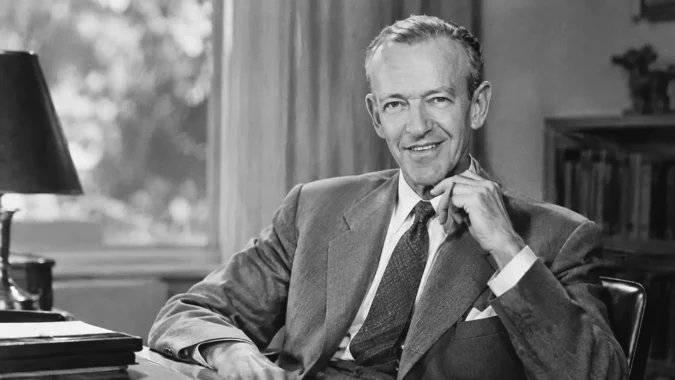

Fred Astaire was an American dancer, actor, singer, and choreographer. He became one of the most famous dancers in movie history. He was known for his smooth style and careful dance moves.
Astaire was born Frederick Austerlitz on May 10, 1899, in Omaha, Nebraska. He became famous for films such as Top Hat, Swing Time, Easter Parade, and The Band Wagon. He was also well known for his films with Ginger Rogers.
Astaire died in Los Angeles on June 22, 1987, at the age of 88.
Quick facts about Fred Astaire
| Fact | Details |
|---|---|
| Full name | Frederick Austerlitz |
| Professional name | Fred Astaire |
| Born | May 10, 1899 |
| Birthplace | Omaha, Nebraska, United States |
| Died | June 22, 1987 |
| Profession | Dancer, actor, singer, and choreographer |
| Best known for | Hollywood musicals and dance films |
| Famous dance partner | Ginger Rogers |
| First wife | Phyllis Potter |
| Second wife | Robyn Smith |
| Children | Fred Jr. and Ava |
| Final film | Ghost Story (1981) |
Early life and stage career
Astaire started learning dance when he was very young. His mother took him and his older sister, Adele, to New York for dance training. The two children soon began performing together.
Fred and Adele became a successful stage team. They appeared in shows such as Lady, Be Good!, Funny Face, and The Band Wagon. Their work took them to theaters in the United States, Britain, and other places.
The brother and sister team became very popular. Adele retired from show business in 1932 after she married Lord Charles Cavendish. Astaire then had to build a career as a solo performer.
Fred Astaire and Hollywood
Astaire moved into films in the 1930s. His early screen work included Dancing Lady in 1933. That same year, he appeared with Ginger Rogers in Flying Down to Rio.
Astaire and Rogers were not the main stars of Flying Down to Rio, but their dance scenes received a lot of attention. Their screen partnership soon became one of the most famous in Hollywood.
They made 10 films together. These included The Gay Divorcee (1934), Top Hat (1935), Follow the Fleet (1936), Swing Time (1936), Shall We Dance (1937), Carefree (1938), The Story of Vernon and Irene Castle (1939), and The Barkleys of Broadway (1949).
Their films mixed music, romance, comedy, and dance. Their performances helped make dance an important part of movie stories.
Why Ginger Rogers was important to his career
Astaire and Rogers became famous for the way they danced together. Their movements looked smooth and natural, but they required careful practice and timing.
Astaire often preferred dance scenes where viewers could clearly see the performers. His films did not always use fast cuts or large groups of dancers. Instead, the camera often stayed on the dancers so people could follow their movements.
Choreographer Hermes Pan was also an important part of many Astaire and Rogers films.
Top Hat became one of their best-known films. It featured music by Irving Berlin and stylish Art Deco sets. Swing Time was also known for its dance scenes.
Their final film together was The Barkleys of Broadway in 1949.
Fred Astaire’s career after Ginger Rogers
Astaire continued to have a long film career after his work with Rogers. He danced with many other stars.
He worked with Eleanor Powell in Broadway Melody of 1940. He appeared with Rita Hayworth in You’ll Never Get Rich and You Were Never Lovelier. He also worked with Judy Garland in Easter Parade, Audrey Hepburn in Funny Face, and Cyd Charisse in The Band Wagon and Silk Stockings.
Some of his important later films included Easter Parade (1948), Royal Wedding (1951), and The Band Wagon (1953).
In Royal Wedding, Astaire performed his famous ceiling dance. In The Band Wagon, he danced with Cyd Charisse in the well-known “Dancing in the Dark” scene.
Astaire also took on more serious acting roles. He appeared in On the Beach (1959), The Pleasure of His Company (1962), The Towering Inferno (1974), and Ghost Story (1981). Ghost Story was his final film.
His role in The Towering Inferno earned him an Academy Award nomination for Best Supporting Actor.
This is my latest article. Please visit it and read it.
Television career
Astaire also worked in television. During the late 1950s and early 1960s, he appeared in television specials with Barrie Chase.
One of these programs, An Evening with Fred Astaire, received several Emmy Awards. His television work showed that his dance style could also work well outside Hollywood movies.
Awards and honors
Astaire received an honorary Academy Award in 1950 for his contribution to film musicals.
He was one of the first people to receive the Kennedy Center Honors in 1978. He also received the American Film Institute’s Life Achievement Award in 1981.
He received other honors during his career, including Emmy Awards and a Golden Globe for his supporting role in The Towering Inferno.
Fred Astaire’s family
Astaire married Phyllis Potter in 1933. They had two children, Fred Jr. and Ava. Astaire also helped raise Peter, Potter’s son from an earlier marriage.
Phyllis died in 1954.
Astaire later married Robyn Smith, a jockey, in 1980. They stayed married until his death in 1987.
Astaire kept much of his private life away from the public. Because of this, some stories about his personal life are difficult to confirm.
Fred Astaire’s net worth
There is no reliable public source that confirms Fred Astaire’s exact net worth when he died.
Some websites give specific figures, but these numbers are often estimates. Without reliable financial or estate records, it is better not to give an exact amount.
Astaire earned money from his work in stage shows, films, television, recordings, and other professional activities.
Fred Astaire’s legacy
Fred Astaire died in 1987, but his work remains an important part of American film and dance history.
His films with Ginger Rogers helped show how dance could be used to tell a story. His later work with other actors and dancers also showed how well he could adapt to different styles.
Astaire was known for making difficult dance moves look easy. His careful timing, smooth movement, and clear screen style made him one of the most important dancers in film history.
Sources
Who Was Fred Astaire? | Our Namesake & Inspiration
Editorial Note: This article was researched using publicly available sources and reviewed for accuracy and originality. Where information is limited or uncertain, we identify it carefully rather than presenting speculation as fact. For corrections or copyright concerns, please contact our editorial team.
Writting by William Foster